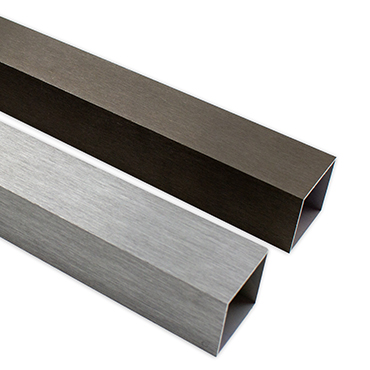

Surface Treatment
Anodizing
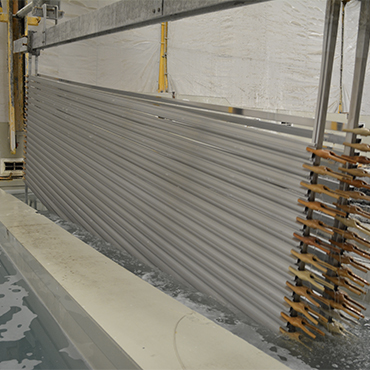
Anodizing is an electrochemical process which increases the surface resistance of the aluminium profile, and protects it against corrosion. In this context, users are also offered different colors to match their aesthetical preferences.
Galmak’s modern anodizing plant has all the equipment required to ensure color consistency and surface quality. With contract anodizing services, the firm’s monthly capacity for anodizing reaches 600 tons of profiles.
- Anodizing bath dimensions - 2500 mm in depth and 8000 mm in length
- Anodizing layer thickness - Adjustable to match the needs of the customer (Standard thickness: 10-12 micron)
- Maximum length of profile for anodizing - up to 7000 mm
- Jig marks - 50-70 mm on both ends, depending on the profile’s geometry
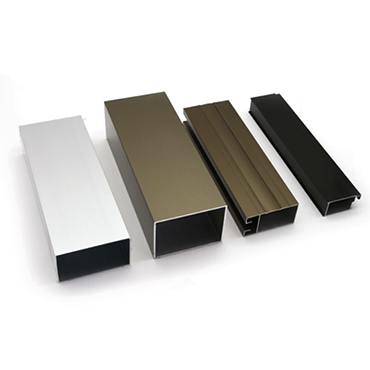
The pre-processing required to prepare aluminium profiles for anodizing are, according to DIN 17611 norm, as follows:
E0…… No pretreatment, only degreased, anodized and sealed.
Die or chafe marks and other surface defects remain visible. Appropriate for hidden surfaces, e.g. to back shadow gaps, push rods etc.
E1…… Grinded, anodized and sealed.
Relatively uniform surface with duller appearance: small die marks or scratches are removed (no surface grinding). Depending on the size of the abrasive grain, coarser or finer chatter marks remain visible.
E2…… Brushed, anodized and sealed.
Uniform, bright surface. Brushing is visible. Die marks, scratches etc. are only partly removed. Easy to clean, high self-cleaning effect on outdoor applications. Most common mechanical pretreatment.
E3 ….. Polished, anodized and sealed.
Glossy surfaces: die marks, scratches etc are only partly removed. Preferred indoor application. Low maintenance.
E4 ……Grinded and brushed, anodized and sealed.
Uniform, bright surface: die or chafe marks and other surface defects – especially hidden corrosion phenomena – that may show for E0 or E6 are removed, (no surface grinding). Low maintenance.
E5…… Grinded and polished, anodized and sealed.
Even, glossy surface: die or chafe marks and other surface defects – especially hidden corrosion phenomena – that may show for E0 or E6 are removed, (no surface grinding).
E6…… Chemically etched, anodized and sealed.
Matt, rough surface: die or chafe marks and other surface defects are partly removed. Material-induced surface defects may not always be avoided. Possible corrosion phenomena affecting the aesthetic appearance and which could not or difficultly be identified prior to etching, may show as a result of this treatment.

ELECTROSTATIC POWDER COATING
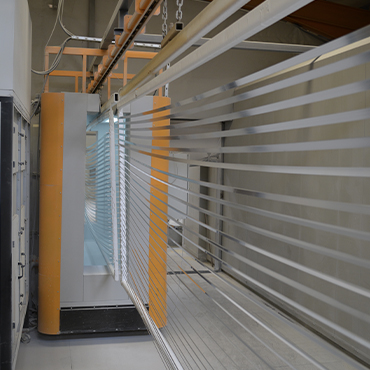
Electrostatic powder coating is a surface coating method which entails coating the part with a powder containing the paint pigments, and thereafter application of oven-drying. Its most significant advantage compared to anodizing is the ability to offer an unlimited range of colors and levels of glossiness.Galmak is able to apply any kind of paint with reference to RAL codes specified by the customer.Capacity of the Electrostatic Powder Coating Plant:
- Horizontal coating plant (ability to offer contract-based vertical coating, as required)
- Maximum length of profile for coating: up to 7000 mm
- Coating layer thickness – Adjustable to match the needs of the customer. (Standard thickness: 60-80 micron)
- Surface and color options – According to the RAL code provided by the customer, or in metallic or special colors outside the RAL code range
SPECIAL SURFACE FINISHES
In line with the requests of the customer or in accordance with the surface sample, Galmak is able to produce different surface textures using polishing and satin finish machines.