History of Aluminium
Even though aluminium is the third most abundant element on earth, after oxygen and silicium, its production on an industrial scale only began in 1886, after the introduction of the electrolysis method.
Just like other widely used metals such as iron, lead and tin, aluminium is available in nature as part of compounds with other elements. The first person to isolate aluminium from its oxide compound was Sir Humphry Davy, who achieved this feat in 1807. Following this, Hans Christian Oersted, Friedrich Wöhler and Henri Saint-Claire Deville developed newer methods to yield aluminium.
Meanwhile, industrial scale production of aluminium began in 1886, with electrolysis applied by Charles Martin Hall in the USA and Paul T. Heroult in France, acting unaware of each other’s efforts. As this method is still essentially the only way to produce aluminium, 1886 is considered as the birth date of the aluminium industry. 1886 saw Werner von Siemens inventing dynamo, followed in 1892 by the development of the Bayer process for deriving alumina out of bauxite by K.J. Bayer.
Thereafter, industrial-scale production of aluminium became easier, which made it the second most widely used metal, after iron.
Characteristics of Aluminium
Characteristics of pure aluminium:
- Chemical symbol: Al
- Atomic number: 13
- Atomic weight: 26.98 g/mol
- Crystal Structure: Face-centered cubic
- Density: 2.6989 g/cm³ at 20 °C
- Melting point: 660 °C
- Boiling point: 2519 °C
- Energy needed for melting: 94.6 cal/g
Aluminium’s characteristics as a metal makes it an ideal and economic material in many cases. The major characteristics of aluminium are as follows:
- Aluminium is light. It weighs approximately one third of an equivalent volume of material made from steel.
- Aluminium is chemically resistant to weather conditions, foods, and many liquids and gases used in daily life.
- Aluminium’s reflective capabilities are significant. Its silvery-white color also contributes to its reflective look, making it an attractive choice in both interior and exterior architecture. The aesthetically pleasing look of aluminium can be preserved for extended periods, thanks to processes such as anodizing and electrostatic powder coating. Indeed in many cases even a simple oxidation layer would suffice.
- The resistance of various alloys of aluminium can match and even surpass the strength of ordinary construction steel.
- Aluminium is an elastic material. That is why it is resistant to sudden impacts. Furthermore, just like steel, it doesn’t become brittle at lower temperatures.
- As a metal, aluminium is easy to process. Indeed, it can be processed to produce foil or wires with a width of less than 0.01 mm.
- The heat and electrical conductivity of aluminium is quite high.
- Any manufacturing method, such as casting, forging, rolling, pressing, extrusion, or milling can be applied to shape aluminium.
- A tensile strength in the 40-540 N/mm² range, achieved through different alloys provides optimal solutions for many fields of application.
What is Extrusion?
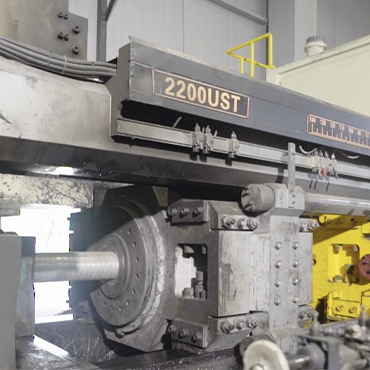
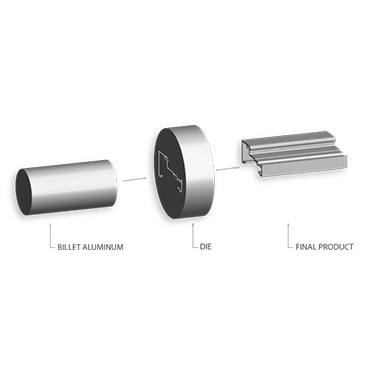
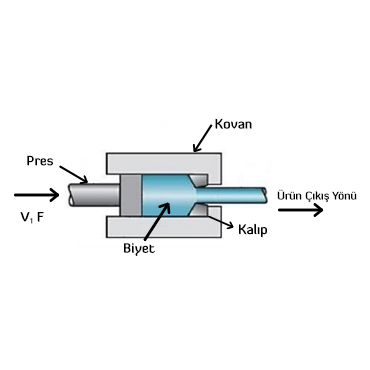
Definition: The process of pushing a cylinder of metal block (billet) placed in a container through a die with pressure applied by a ram is called extrusion.
Extrusion is roughly comparable to squeezing toothpaste out of a tube.